Recommendations for this week, or the second half of March, or the spring, or the Summer:

 Chamber Music for Lawn Mowers

This is, I think, my favorite thing I listened to in 2025, and overall maybe my favorite art I experienced in 2025. It is an experimental album by a project called S. Martens, a collaboration between artists M. Sage and Leiven Martens. M. Sage describes it, and its inception, much better than I can on his Substack here. I so rarely feel like conceptual art does what it claims to do (and I guess it doesn’t even really make sense to call this conceptual, because it’s not like it seems to be clearly concept driven and it is (to me at least) mostly good music that is genuinely pleasant to listen to), but when I read just today that he feels it contains some “big post-colonial and ecological ideas” I couldn’t help but think that this might be one of the rare cases when I believe that it just might actually have some of that stuff in it. Maybe it is just that I will allow anyone anything if the art makes me feel something. 

Either way, I listened to it for most of last year without thinking about it on an idea or concept level at all and we highly recommend it.

The Sickness Unto Death by Soren Kierkegaard

It really shouldn’t be underestimated, it cannot be overestimated, how much I loved this book. The first paragraph makes it an incredibly hard sell and I know for a fact the book is not for everyone–I read it as part of a reading group where I was definitely the only one who loved it unreservedly, and I think very few people had much love for it at all. But I found Kierkegaard’s complex system of the self convincing, his psychological portraits sharp and believable, and his description of the risk of humiliation in faith moving. Highly recommend!

It was funny to be in a reading group for the first time since college, this one was full of serious San Francisco tech guys/various white-collar-job-havers. But, in general, I’m grateful for the structure to read something I certainly would not have finished otherwise and for the (at times too serious even for me) environment in which to discuss ideas. It is so hard to be talking at all about the same thing when you read and try to discuss philosophy together; it is I guess philosophy’s problem all the time, shared language and do we mean the same thing by history or the self or the mind as the other guys. By the end of seven weeks (2 hours a week, 7-9pm!, insane) we got a little better at this, but not much.  

Yellow guavas

At the corner store near my house they have yellow guavas. They smell intense, like Kerns guava juice that my grandparents always had in the fridge. They taste like that but better and they have a custardy inside with hard seeds that will break your teeth. I usually bite down until my teeth hit the seed but do not try to go further and swallow them whole and we highly recommend. 

bookbinding, more to come soon

Been doing lots of bookbinding lately, using lots of paper. Because I have a neurotic aversion to paper waste and am losing faith that I will use my scraps for papermaking anytime soon, I have been making tiny notebooks with the odds and ends. Nothing fancy but if you want a tiny notebook, approx. 1.5″ square, email me at darizeltser@gmail.com with your address and I’ll send you one. Only payment required is you have to write in it at least once and send me a photo.

Love, D

Reading #1

The Varieties of Religious Experience by William James

I have been lately reading somewhat more old books (more books and more old). Not so old, I still haven’t made much ingress into the ancients, but my interest in reading them comes, I think, from reading more from the mid 19th to the early 20th centuries. One thing that comes up as I read things from this time period is that I don’t, or can’t, feel the cultural or emotional valence of mythological (or biblical) references widespread in books, fiction and nonfiction, before 1980 (maybe more conservatively before 1960). (1) I want to understand myth. More than understand it, I want to feel the heavy historical and psychological and cultural weight of it, but I’m not sure how to yet. Can you really feel the resonance of an allusion to a biblical story without having heard it, at least once, as a child? Can I convince myself of the power of these weird old stories when their influence on culture has become so coded and diffuse? Modern stories touch me more easily, but I am stubborn and I want to understand, and to feel, the old ones, too. (2)

But there is a slow, small change in me occurring. The Varieties of Religious Experience was originally published in 1902. I have, throughout my life as a sub par (at best) scholar, tried to and been assigned to read a lot of things written around that time. Very few of them touched me in the past. I thought I understood the things I read well enough in college. I never felt that engaged but I attributed that at times to being distracted, at times to having too much work in general, but now I think there is something else here besides. It is about the difference between understanding and connecting. The reading I do now, despite my not having much more actual knowledge of context, feels more connected to the threads of the world I inhabit. Somehow, maybe through years of a glacial osmotic absorption of historical literary trends and political and artistic movements, or through a chemical change of my own mind, the minds and writings of people 100 plus years ago feel more present to me. They feel not only like real people with interesting and relevant ideas, but like real people with humor and solidity and existence in a world I can orient myself in. I am not sure what to attribute this to, besides age and effort, and maybe meditation and a Lion’s Mane supplement that’s finally working.  

Anyway, the first section of James’s table of contents, pertaining to the first lecture, reads as follows:

RELIGION AND NEUROLOGY

Introduction: the course is not anthropological, but deals with personal documents, 21. Questions of fact and questions of value, 22. In point of fact, the religious are often neurotic, 24. Criticism of medical materialism, which condemns religion on that account, 27. Theory that religion has a sexual origin refuted, 28. All states of mind are neurally conditioned, 29. Their significance must be tested not by their origin, but by the value of their fruits, 31. Three criteria of value; origin useless as a criterion, 33. Advantages of the psychopathic temperament when a superior intellect goes with it, 36; especially for the religious life, 37.

Each lecture gets this treatment, described not with chapter headings and subheadings, but with short notes outlining ideas covered and their page number in the text. Some phrases are self explanatory–you don’t need to read it at all to know that he refutes the theory that religion has a sexual origin, unless you want to know how he does so–but some are more opaque, “Three criteria of value; origin useless as a criterion.” Either way, they guide you through the text, almost from the inside, the way that a traditional table of contents does not. There are no headings within the text and it’s not totally clear that these are even the most important parts of the lecture, necessary for his point to stand. This, for me, is the exciting part; in this table of contents, James creates a sense that it is important to him that we be made explicitly aware of his own thinking through of the problems and tangents that make up his subject–I think this effect is emphasized by the note’s jotted quality. It satisfies me particularly because in James’s winding and tangential lectures, it’s not that he doesn’t get to the point, but it is clear that it is important to him that we understand how he is thinking about all of this, and what’s at stake (and that there’s something at stake) in understanding how he thinks about it, as opposed to how someone else might. 

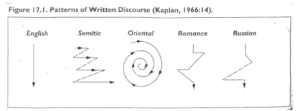
Here’s a diagram that I, admittedly, was made aware of for the first time on TikTok (I am now off TikTok, but thanks, I guess, for this): 

The paper it comes from is interesting, and I’ll get into it maybe more deeply in the future in order to write about something else, but for my current purposes this diagram serves its function as is, out of context. While surely a simplification, I think it illustrates something that reading James and thinking about this table of contents makes me think about, which is the way we are taught to conceptualize ideas, as arguments. In order to understand something, we must understand the linear points which prop it up, and the organization of ideas is unidirectional. As an American who only speaks English, but who has never felt quite comfortable in the straightforward, argumentative way we are taught to think about ideas, I find this quite pleasing. 

The way it connects to James’s table of contents is thus: that while the direction of the pages in a book move only forward and upward in number and the table of contents must follow suit, his thought moves variously and widely around. It models a system where learning and thinking is osmotic and suffusive as opposed to linear, by which I mean that you are immersed in a million ideas swirling all around you and each, while not leading directly to the other, influences the other in subtle and unseen ways. They all carry a certain force or energy like magnetism that attracts or repels the others. Whether I believe this because it is how I think, or whether it actually speaks to the “reality” of how ideas operate around or in relation to each other, I do not know, but James’s table of contents, in its matter of fact idiosyncrasy, constructs an odd allegory for this kind of thinking. 

Maybe also I can return here to what felt like a tangent earlier, something I couldn’t stop myself from writing but that felt related only obliquely to my choice of subject. I have spent many years since college trying to teach myself things, and I have come to many conclusions about the possibility of doing so and the need (my need) for structure. But something I keep being shown is that while I have always felt like I have failed, I have actually succeeded: I know more than I used to. I am particularly adept at creating arbitrary rules for myself about what it means to actually work, or actually succeed, or actually try hard, or actually learn, and I am invariably failing to meet my own standards. I almost never finish non-fiction, I half-read 6 essays per day, I imagine many, many more creative and literary projects than I ever finish–in fact I finish almost nothing that I start. But to my very happy surprise this has still amounted to something. I am a more patient reader than I have ever been before; I understand better my own interests; objects and people in history have a setting and a context; I have heard that name before. 

I am interested in more depth, more diligence, more continuity, more rigor, more writing, but I am starting from not nowhere, not nothing. If I never felt like I was learning, never feel enough like I have learned, then what is happening? Maybe this is intuition in the psychedelic Jungian sense, intuition as download from God, and God is just everything you have ever seen and read and heard, mixing and twisting within you. 


Footnotes

(1) Every so often a contemporary writer will be a classicist, like Anne Carson or Helen DeWitt, but they are clearly exceptions not rules. Someone, somewhere (god I need to start clipping and noting the things I read) wrote that they don’t seem to make critics or writers quite like Susan Sontag anymore, who had read something like every book in the Western Canon by the time she was 25, but then again she was 25 in 1958 which, due to the conversion rate, makes it equal to about 35 today. There’s something here about the dissolution of the canon et cetera and I do think I feel a bit robbed of a familiarity with what were once obviously shared cultural reference points. I was a somewhat (unknowingly) unambitious undergraduate at a Jesuit liberal arts college not known for its rigor so I could get away with my religion credit just being a class called “Ecology and Faith” that gestured vaguely at comparative religion and the natural world.

(2)  Since writing, I’ve read this blog post by Alan Jacobs that responds, somewhat to the question of whether we should, or whether it is even possible to, connect with writings from history. It is my cross to bear that anything I think or wonder is already a subject of scholarly debate of which I know nothing. This used to stop me in my tracks, but now I must go on.


Nothing anyone else thinks matters

Nothing anyone else thinks matters. Obviously I don’t think this, but also, I do. Nothing anyone else thinks can matter, for a few reasons and in a few ways. For one thing, people think all kinds of different things. For everyone who thinks something, someone else thinks something else, opposite. This may feel like it leads to relativism, and it does. But also it doesn’t. Because if what other people think doesn’t matter, it doesn’t mean you can’t think about what they think, or what you think in response, just that it doesn’t matter what anyone thinks, except to themselves. This allows you to think dispassionately and disinterestedly, which is the best kind of thinking (although obviously not the best kind of living).

Disinterestedly is a funny word because it means, in this case, without your own agenda, and not, without interest, like it might seem. I have read it used this way before, which is why I am using it this way, but every time I read it, used this way, I am confused by it, which is why I like it.

For another thing, other people’s ideas are interesting, and can be useful, but aren’t always. For example: I read a Substack essay yesterday in defense of reading secondary sources about literature. Then I read the comments which included a defender of the original point making the (to my mind unnecessarily vulgar!) claim that “Studying literature from a historical angle is scholarly masturbation.” This is something I could get stuck on–should we read secondary sources–and I could, and probably have at some point in the past, decided that the original idea-haver is right, that somehow secondary sources muddy the waters of literary interpretation, and that what’s most important is for people (in this case students) to have their own experience of the text, unsullied by anyone else’s opinion. It’s funny because now this is an essay against taking into account other people’s opinions using an example in which I, ultimately, disagree with someone who says you shouldn’t read other people’s opinions about something. And I guess that means that I think they’re right, and wrong. 

Nothing anyone else thinks matters, because what you think matters most, and first, because what you think definitely does matter, if only as a starting place. What other people think matters less than none, but feels like it matters more, if you don’t know what you think. Once you know what you think, then maybe things that other people think can start to matter. But if you’re floating, lacking an anchor, in the fucked up sea of other people’s ideas, which many of us are, then what you think matters most and first. 

And anyway, what does it mean for something to matter? Sometimes, it just means it’s worth taking into consideration at all. This allows for the most extreme interpretation of my original statement, making it mean that nothing anyone else thinks is worth taking into consideration. I don’t think that, but I could. 

A different definition might be more right in which mattering means that an idea gets a certain weight, or means something about what you must think in light of it; for something to matter in this way, it might have certain criteria. One might be that it must come from someone you trust, or someone who you think is smart(er than you). In this case, the meaning of what I said might mean, “nothing anyone else thinks matters, unless it comes from someone you trust or think is smart, in which case it does, and it must necessarily affect what you ultimately think.” It’s easy to feel like the ideas that come from someone you trust or respect deserve more consideration, but that’s a dangerous way to think, because then I think that makes you give them less consideration. Not letting what anyone else thinks matter to you allows you to give each idea its due consideration which could be none, or some, or a lot. Don’t give any ideas too much consideration until you have given your own a lot of consideration, unless an idea is helping you give your own consideration. 

None of this makes any sense in the context of something else I think, which is that everything that I think is probably what someone else has thought and I have heard or read and integrated on accident. But this is maybe why it’s useful to think, “nothing anyone else thinks matters.” Maybe you will hear or read and integrate less of what other people think on accident, and at the very least only develop new ideas on purpose when you think you are thinking your own thoughts. 

Music is so awesome

9/24/25

This writing at the moment inspired by a relisten of the Brian Eno/John Cale album, “Wrong Way Up,” which also incidentally has some of the awesomest album art of all time. Not a no skip album for me, but some good ones. 

The first song goes:

“I am the wheel / I am the turning / and I will lay my love around you.”

“I am the will / I am the burning / and I will lay my love around you.”

With strings!! Music is so awesome.

I have been lucky to see some really awesome live music this year. Live music, I always manage to forget and then remember and then forget and then remember, is one of the great joys of being alive on earth. To me. There’s nothing that makes me feel closer to humanity and to whatever God is than music played loud out loud by people. Even if they are not that good at it it is awesome, but it is especially lucky when it is good.

Some noteworthy shows so far:

Pinback: I love this band. I already loved this band but seeing them live was especially awesome because they’re so freaking good at it, their music is hard to play but they make it look easy, why are they singing such complex melodies and harmonies? Rob Crow is weird as hell obviously and I regretted not seeing his solo show earlier in the year. Hopefully he’ll come back. I don’t remember if it was me or Isaiah who said it originally, but we agreed that they were somehow.. soulful? (As compared, unfortunately, to J. Mascis who, when I saw Dinosaur Jr., couldn’t even be bothered to screw up his eyes when he did that wail. I think he should have to twist his face up a little bit to make a sound like that, and the fact that he didn’t made it all seem a little false.) Anyway, Pinback was one of the best shows I have ever seen.

WITCH: Is a Zamrock band that got big in the 70s after the Zambian revolution. Zamrock is basically psych rock with African rhythms and influences and it is so awesome. WITCH was a random ticket buy and was easily one of the best shows I’ve ever seen. The frontman, Emanuel “Jagari” Chanda, was incredibly charming, eating fruit on stage the whole time, pulling grapes out of his pockets, throwing them into the air and catching them in his mouth, peeling and eating half a banana at a time. I read later that his stage name, “Jagari,” is either because people compared him to Mick Jagger, or because he was obsessed with Mick Jagger, depending on what you read, but either way it shows. This is one of the only shows I’ve seen where stage presence feels like a relevant thing to mention, mostly because this man had a presence that was palpable, almost mystical, almost like a religious leader. 

It’s crazy because WITCH got big in the 70s when most of their members were in, I think, their mid-late teens, and then pretty soon after the economy crashed and Zambia was hit particularly hard by the AIDs epidemic and it basically ceased to be a place where you could have a successful rock band, so they mostly disappeared. Their record was re-released randomly in the states in 2012 and that’s when they started touring internationally, almost 30 years later. Also, I am a bad instrument hearer so I didn’t notice until Isaiah said something, but once I noticed the guitar player was without a doubt the best I’ve ever seen in real life (this means relatively little from me, but more coming from Isaiah, who said it too. And I’m NOT just saying it cuz he is).

Pedro the Lion: It was a Grandaddy show technically, but we were there to see Pedro the Lion. We stayed for half-ish of Grandaddy and they were very good (I never realized that they are essentially The Flaming Lips?), but we were there to see Pedro the Lion!! This show was not what I expected it to be, mostly because I had mostly listened to two very old albums and he is still writing and releasing music. Usually I’m sort of a brat about this kind of thing and can’t really get into a show if they’re not playing anything I know very well (this happened earlier this year with Gillian Welch, to my dismay), but in this case I was a good sport, due mostly to the fact that holy shit that guy can sing. You always hope a guy who sings can sing, but sometimes they kind of can’t, or they can but kind of just ok, or the version on the album was the best take by a lot, etc. But not so with David Bazan!! He has a powerful, clear voice. 

The albums of his I know best are It’s Hard to Find a Friend and Control which are, in so many words, emotionally sick–that’s what I love about them–so that’s sort of what I was expecting from the set. But I had forgotten that the new stuff isn’t like that at all, and maybe they were also doing something more upbeat to cater to the Grandaddy crowd, I don’t know. But either way, I was expecting to leave feeling like I had been punched in the gut and it was actually quite a bit more friendly feeling. Not chipper exactly, but the neurotic-depressive alt rock version of that, maybe. Bazan was weird on stage in a way that I liked, especially when he started to make a joke that he stopped himself from making by saying, “my unconscious will thank me for not saying this later,” almost said it anyway, and was only stopped by his bandmate slowly shaking his head at him. 

(OMG I’m still listening to this Eno/Cale album and this song, “The River,” sounds like the precursor to every bad Devendra Banhart indie you’ve ever heard. Mistake!!) (As a disclaimer, I will sometimes be a shithead on this blog about my taste in things. It is fine if you disagree, and I’m not here to hurt any feelings, but I have a lot of opinions that are somewhat abrasive and I cannot apologize for it. Not on my blog. If you want to make yourself feel better by noticing a grammatical error or just thinking my writing is bad that’s totally fine too, I encourage it! Just don’t raise your taste related issues with me. Or do. Maybe I’d like to talk or think about them.) 

We went on a ticket buying spree a few weeks ago (in which some of these shows were included) because there were a bunch of shows I wanted to see and we know we won’t go unless we’ve already bought the tickets, so coming up Isaiah and I are seeing Autechre, Sean Nicholas Savage, Drop Nineteens & Ee (this is a weirdly stacked bill, bunch of other bands I can’t remember, I’m scared I bought a ticket to a festival or something but it wasn’t that expensive and I haven’t looked into it), and Cap’n Jazz & Rainier Maria. Will report again later if any of these are worth reporting on. 

Anyway, music is awesome, that’s the general point. Go see more live music if you like it. I’m suddenly remembering my friends Ellie and Dan talking about how they don’t like to see music live, their backs hurt while standing, Dan saying “what–I want to see them play the songs I like differently than the way I like them?” 

21 September 2025 New Moon Tarot Reading

Isaiah and I somewhat regularly do tarot readings on the New Moon. I read somewhere sometime that the new moon is the time of the month when it’s best to set intentions–something about the absence of light being the space to imaginally fill with what you hope could come to be (or something).

Obviously, upon learning this probably from Pinterest or something, I started to get a little bit neurotic on the day of and days surrounding the new moon; if I did the wrong thing then I was manifesting the wrong thing for my whole month. This usually would send me into a state of anxious paralysis, practically ensuring I would watch YouTube Shorts all day. Then I would think, great, now I’ve manifested YouTube Shorts brain. And repeat. (I highly recommend, if you accidentally start to believe in manifestation, that you also somehow manage to believe that only positive manifestation is possible.)

This has lessened somewhat as I have finally figured out a way to log myself out of my phone reliably and regularly (phone in greyscale, black background, apps all hidden from home screen, and the most important, an app called Foqos that blocks all the apps you ask it to in a way that you can’t bypass without a QR code that it generates for you–they recommend you print it out and put it somewhere, I have Isaiah keep mine on his phone). I want to write soon about what this has felt like and done to my brain (spoiler: it’s good), but for now the point is that I can’t accidentally manifest short form video content of the mind because I can’t watch it. Now, the worst thing I could do on a new moon is spend all day looking at job listings for the field that I may imminently be joining and have some anxiety about the job prospects therein, better and in some ways more avoidable but still not the best.

Anyway, sometimes doing a tarot pull that day is helpful, sometimes it is not, but can be useful and fun to think through, as the pull lays out, where you are now, what’s blocking you, what you need to know, what intention you should have for the month ahead, and what might emerge.

On Sunday, we each did this pull, and I am self-centeredly (my blog) going to focus on mine.

Here is my spread:
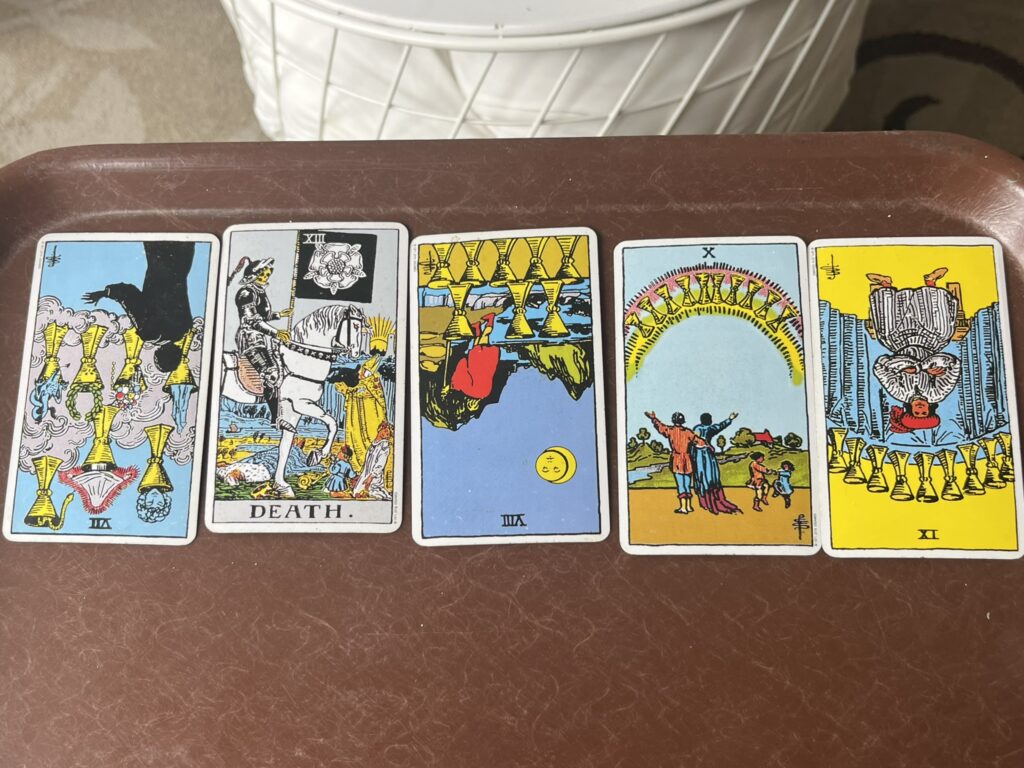
 

Sort of a crazy one! The 7, 8, 9, 10 of cups, and Death.

Where I am now: 7 of cups reversed.

I hate this card. Partly I’m just in a bad mood this morning, but it reminds me of myself when I’m trapped in the world of either positive or negative fantasy, neither of which feel very good. I am, in general anyway, much more prone to negative flights of fancy and feeling hunted by some poorly sketched, unreal and only half acknowledged fear lurking just below the surface. This card makes me think of having 100 tabs open, in a bad way. Really though, in its current position and reversed, I’m taking it as a good place to start (I was in a better mood when I pulled it, too). Sometimes a reversed card can be either an emerging or a fading away of the energy, and I’m particularly hopeful that it is a fading away. I can get really stuck with 100 tabs open in a bad way, doing obsessive job outlook research, going down 100 paths in my mind, each becoming more overwhelming with the addition of the potential next, and even good or interesting or exciting things can cease to be so in this environment. I’ve been becoming more and more aware of this tendency in the past few weeks and months, and I hope this means that I’m starting to step away from it.

What’s blocking me: Death

Scary! But as we also know, not. Often just described as a card of transformation, I think it’s also interesting to think of as the difficulty of, or maybe even resistance to, change. In this case, I’m taking it as the card of, “old habits die hard.”

What I need to know: 8 of cups reversed

This is the one I have the least well fleshed out thoughts about. There is a somewhat uncomplicated interpretation of the imagery in the traditional reading of the card, which is usually something about leaving behind what no longer serves you. This surely applies, there are all of those messy cups from the 7, there I go, turning away; the reversal confuses things a bit, if only because I’m never sure exactly how I want to read them, it’s easy for me to get caught up in the potential double negatives (is it this or the opposite of this? If you pull a reversal in a blocked position… etc.). Often I lean towards the idea that reversed cards point to something internal as opposed to out there in the world, and I suppose that fits too. It feels a bit too neat to me, but that might just be me being difficult.

A thought I’m just now having is about the path of the traveler in this card, up into the mountains, into the unknown. This feels a little deeper and a little stickier because it’s something I’ve been thinking about a lot. The 100 tabs are open because I’m trying to gather information, because I’m afraid of not knowing what lies ahead of me. The path away from them is into the unknown. 

Intention needed: 10 of cups

That’s nice! I think it’s useful to compare the 10 to the 7 here since in some ways their activity is the same: looking up at cups. But where the 7 is specific and somewhat threatening (or is that just me), the 10 is broad and open. Here, the figures are not swallowed up by the fantasies of the cups, but given equal weight, living in the light of them, gazing up, but not at the expense of the broader world. This is helpful. I recently have been thinking a ton about the idea of “knowing what you want,” what this asks of you, whether it’s possible, at least in specific terms, whether it’s even useful (at least, I guess, to me). Potentially more on that to come soon, but for the time being it’s enough to say that I have found the demands to know what I want, with specificity, and to figure out from there how to get it, to be what leads me down the 7 of cups path. Suddenly I have a truly impossible number of looming 5 year plans and no way of knowing which is “right.” But if you ask me what I want, what I really want, and I don’t have to be specific at all, it’s easy. I want to be happy; I want to be interested in my life; I want to sit in the sun; I want to be serious but not too serious about my work; I want to think, alone and with other people; I want to feel capable; I want depth and breadth, both. This feels like the promise of the 10 of cups and what it is telling me it is OK to want, and this card seems quite importantly broader than the seven.

And then, I’m not sure it’s even a card of wanting. In the 10, you already have it; really, it feels like a card of basking and acknowledgement more than desiring at all. I had a conversation with Isaiah’s mom when we were in Michigan about how I had been thinking that I needed some way to signal to myself that I had accomplished things day to day, because I often feel by the end of the day that everything I’ve done is nothing (the sinking hopelessness of the evening), and I’d been pulling the four of wands a lot, a card that is often described as a card of celebration. I had gotten stuck on the word celebrate–it’s the kind of word used in a lot of self help-y, self love content and I can’t quite make it feel sincere. She told me that she likes the word acknowledge better and that she had recently looked up its meaning: to accept that you know. This might be the ten of cups here, an acknowledgement, look what you already have.

What will emerge: 9 of cups reversed

I mean, look at him! Great news. For me, this reversal could be internal or emerging, both seem right enough. What feels important is a confident turning away from the cups themselves. Where in the seven the cups are bright and gaudy and the figure is dark, here the cups are solid but not overbearing, and the figure sits in front, facing away, in the light. Who do you get to be when you aren’t afraid anymore, aren’t seeking desperately, when you know you have what you need?
 

Rorschach tests, validity and reliability, extrapolation, and statistics

Here’s something I wrote a while ago. It was written while I was taking basic psychology classes because I thought I was going to become a therapist. 

8/29/24

In class we’re talking about personality tests. We’re talking about the Rorschach. We’re talking about reliability and validity. 

Validity means: are you measuring what you think you’re measuring or what you mean to be measuring. 

Reliability means: do you get consistent results. 

With regards to the Rorschach, the question of validity can be made to make sense, I think. The question is, maybe, does this lead in a meaningful direction? And if you believe in the Rorschach and on the meaningfulness of unconscious image or story creation the answer can be yes. (But maybe it is only yes conditionally, depending on the ability of the interpreter so then it is not a question of instrument at all but of the talent or competence of the psychotherapist administering the test. The Rorschach can lead you in a direction but can you tell which direction it is pointing?) 

Reliability is potentially more confusing. Perhaps the strength of the Rorschach is in its unreliability, its lack of right answer. If the Rorschach was reliable it would be a photograph of a butterfly, and although it would be reliable it would not be useful. I think maybe reliability in the case of the Rorschach or a psychological or personality test like it would be a weakness… but then I think I’m misunderstanding or misrepresenting. 

In a reliable personality test, it’s not that you want everyone to get the same result, but that you want everyone who really is that way to get the same result as everyone else who really is that way. You want people with the same strengths and deficiencies and tendencies to respond the same way. I don’t know that I see that as a feasible or even worthwhile goal. The alternative to this for me is that each individual is individual, you can only begin and end with the person in front of you, everything else is projection, but that might just be me being a binary thinker. Of course both are useful. 

Science and statistics are a marvel, the attempt to isolate variables and reliably explain behavior, to categorize and diagnose and qualify and explain, are all part of what makes grounded theory possible, but I can’t seem to be convinced that it is the only way to develop good theories. Or certainly the only way to do good clinical work. Case studies are ungeneralizable but not useless. What can be extrapolated? Why do we need to extrapolate? 

I think maybe the way to get my head around the statistical problems of generalizability is to think of it this way: if you develop a correlation, 99% of people who are like A are also like B, it doesn’t mean that in your practice all or any of the people who are like A will also be like B, because statistics do not describe people, they describe statistical tendencies within a population. So it may be useful to look into B if someone is A, but not to diagnose or prescribe or project B onto them. Although a case study cannot be used to argue that anything is likely to happen to anyone else, I’m not sure that the most valuable research needs to be extrapolable, or that it is valuable to think of anyone as fitting within even an empirically grounded model of their behavior. The only thing empirical about an individual is what can be observed about them specifically. I guess this ends up just being against broad theoretical projection in general instead of in favor of less “scientific” methods like the Rorschach.. I just like “un scientific” methods.. I can’t help it..

×