
The Varieties of Religious Experience by William James
I have been lately reading somewhat more old books (more books and more old). Not so old, I still haven’t made much ingress into the ancients, but my interest in reading them comes, I think, from reading more from the mid 19th to the early 20th centuries. One thing that comes up as I read things from this time period is that I don’t, or can’t, feel the cultural or emotional valence of mythological (or biblical) references widespread in books, fiction and nonfiction, before 1980 (maybe more conservatively before 1960). (1) I want to understand myth. More than understand it, I want to feel the heavy historical and psychological and cultural weight of it, but I’m not sure how to yet. Can you really feel the resonance of an allusion to a biblical story without having heard it, at least once, as a child? Can I convince myself of the power of these weird old stories when their influence on culture has become so coded and diffuse? Modern stories touch me more easily, but I am stubborn and I want to understand, and to feel, the old ones, too. (2)
But there is a slow, small change in me occurring. The Varieties of Religious Experience was originally published in 1902. I have, throughout my life as a sub par (at best) scholar, tried to and been assigned to read a lot of things written around that time. Very few of them touched me in the past. I thought I understood the things I read well enough in college. I never felt that engaged but I attributed that at times to being distracted, at times to having too much work in general, but now I think there is something else here besides. It is about the difference between understanding and connecting. The reading I do now, despite my not having much more actual knowledge of context, feels more connected to the threads of the world I inhabit. Somehow, maybe through years of a glacial osmotic absorption of historical literary trends and political and artistic movements, or through a chemical change of my own mind, the minds and writings of people 100 plus years ago feel more present to me. They feel not only like real people with interesting and relevant ideas, but like real people with humor and solidity and existence in a world I can orient myself in. I am not sure what to attribute this to, besides age and effort, and maybe meditation and a Lion’s Mane supplement that’s finally working.
Anyway, the first section of James’s table of contents, pertaining to the first lecture, reads as follows:
RELIGION AND NEUROLOGY
Introduction: the course is not anthropological, but deals with personal documents, 21. Questions of fact and questions of value, 22. In point of fact, the religious are often neurotic, 24. Criticism of medical materialism, which condemns religion on that account, 27. Theory that religion has a sexual origin refuted, 28. All states of mind are neurally conditioned, 29. Their significance must be tested not by their origin, but by the value of their fruits, 31. Three criteria of value; origin useless as a criterion, 33. Advantages of the psychopathic temperament when a superior intellect goes with it, 36; especially for the religious life, 37.
Each lecture gets this treatment, described not with chapter headings and subheadings, but with short notes outlining ideas covered and their page number in the text. Some phrases are self explanatory–you don’t need to read it at all to know that he refutes the theory that religion has a sexual origin, unless you want to know how he does so–but some are more opaque, “Three criteria of value; origin useless as a criterion.” Either way, they guide you through the text, almost from the inside, the way that a traditional table of contents does not. There are no headings within the text and it’s not totally clear that these are even the most important parts of the lecture, necessary for his point to stand. This, for me, is the exciting part; in this table of contents, James creates a sense that it is important to him that we be made explicitly aware of his own thinking through of the problems and tangents that make up his subject–I think this effect is emphasized by the note’s jotted quality. It satisfies me particularly because in James’s winding and tangential lectures, it’s not that he doesn’t get to the point, but it is clear that it is important to him that we understand how he is thinking about all of this, and what’s at stake (and that there’s something at stake) in understanding how he thinks about it, as opposed to how someone else might.
Here’s a diagram that I, admittedly, was made aware of for the first time on TikTok (I am now off TikTok, but thanks, I guess, for this):
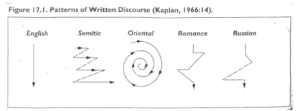
The paper it comes from is interesting, and I’ll get into it maybe more deeply in the future in order to write about something else, but for my current purposes this diagram serves its function as is, out of context. While surely a simplification, I think it illustrates something that reading James and thinking about this table of contents makes me think about, which is the way we are taught to conceptualize ideas, as arguments. In order to understand something, we must understand the linear points which prop it up, and the organization of ideas is unidirectional. As an American who only speaks English, but who has never felt quite comfortable in the straightforward, argumentative way we are taught to think about ideas, I find this quite pleasing.
The way it connects to James’s table of contents is thus: that while the direction of the pages in a book move only forward and upward in number and the table of contents must follow suit, his thought moves variously and widely around. It models a system where learning and thinking is osmotic and suffusive as opposed to linear, by which I mean that you are immersed in a million ideas swirling all around you and each, while not leading directly to the other, influences the other in subtle and unseen ways. They all carry a certain force or energy like magnetism that attracts or repels the others. Whether I believe this because it is how I think, or whether it actually speaks to the “reality” of how ideas operate around or in relation to each other, I do not know, but James’s table of contents, in its matter of fact idiosyncrasy, constructs an odd allegory for this kind of thinking.
Maybe also I can return here to what felt like a tangent earlier, something I couldn’t stop myself from writing but that felt related only obliquely to my choice of subject. I have spent many years since college trying to teach myself things, and I have come to many conclusions about the possibility of doing so and the need (my need) for structure. But something I keep being shown is that while I have always felt like I have failed, I have actually succeeded: I know more than I used to. I am particularly adept at creating arbitrary rules for myself about what it means to actually work, or actually succeed, or actually try hard, or actually learn, and I am invariably failing to meet my own standards. I almost never finish non-fiction, I half-read 6 essays per day, I imagine many, many more creative and literary projects than I ever finish–in fact I finish almost nothing that I start. But to my very happy surprise this has still amounted to something. I am a more patient reader than I have ever been before; I understand better my own interests; objects and people in history have a setting and a context; I have heard that name before.
I am interested in more depth, more diligence, more continuity, more rigor, more writing, but I am starting from not nowhere, not nothing. If I never felt like I was learning, never feel enough like I have learned, then what is happening? Maybe this is intuition in the psychedelic Jungian sense, intuition as download from God, and God is just everything you have ever seen and read and heard, mixing and twisting within you.
Footnotes
(1) Every so often a contemporary writer will be a classicist, like Anne Carson or Helen DeWitt, but they are clearly exceptions not rules. Someone, somewhere (god I need to start clipping and noting the things I read) wrote that they don’t seem to make critics or writers quite like Susan Sontag anymore, who had read something like every book in the Western Canon by the time she was 25, but then again she was 25 in 1958 which, due to the conversion rate, makes it equal to about 35 today. There’s something here about the dissolution of the canon et cetera and I do think I feel a bit robbed of a familiarity with what were once obviously shared cultural reference points. I was a somewhat (unknowingly) unambitious undergraduate at a Jesuit liberal arts college not known for its rigor so I could get away with my religion credit just being a class called “Ecology and Faith” that gestured vaguely at comparative religion and the natural world.
(2) Since writing, I’ve read this blog post by Alan Jacobs that responds, somewhat to the question of whether we should, or whether it is even possible to, connect with writings from history. It is my cross to bear that anything I think or wonder is already a subject of scholarly debate of which I know nothing. This used to stop me in my tracks, but now I must go on.